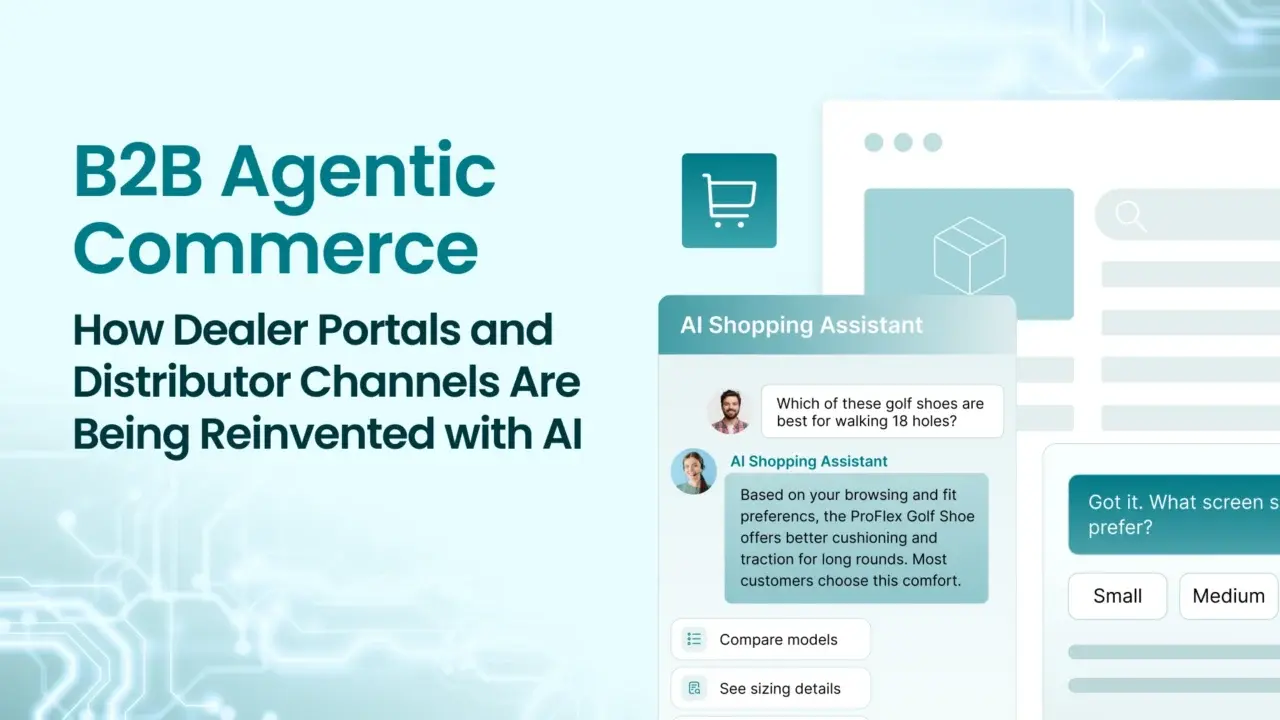
B2B agentic commerce lets buying agents place orders for procurement teams through dealer portals and distributor channels, using the same AI agent infrastructure as B2C but with multi-party authorization, custom pricing and contract terms baked in.
A procurement manager tells their AI agent to reorder office supplies under contract terms. The agent authenticates with the distributor’s portal, applies the negotiated pricing, checks against the buyer’s approval thresholds, places the order and routes it to the right cost center. The infrastructure beneath B2B agentic commerce is similar to B2C but the authorization layer is richer.
What Is B2B Agentic Commerce?
B2B agentic commerce is the application of AI agents to the specific complexity of business-to-business transactions: account-based pricing, approved product lists, multi-line purchase orders, complex catalog structures with technical compatibility requirements, and the repeat reorder workflows that characterize the majority of B2B commerce volume.
The distinction from B2C agentic commerce matters. B2C AI shopping is fundamentally about discovery. B2B agentic commerce is about operational efficiency in a context where the buyer often knows exactly what they want, has account-specific constraints on what they can purchase, and needs the AI to work within a defined relationship structure.
In a B2B agentic commerce environment, the interactions look like this:
- A dealer logs in and describes their reorder needs. The AI agent reviews the dealer’s purchase history, identifies products that match the cycle timing, checks current inventory levels, filters the list to items on the approved product catalog at contracted pricing, and presents a draft order for the dealer’s review. The entire workflow takes four minutes, down from the 40-minute manual reorder process it replaces.
- A procurement buyer needs a component replacement. The AI agent searches the catalog against specified compatibility attributes, filters results by the account’s contracted pricing tier, and surfaces three options with a compatibility confirmation for each.
- A distributor rep wants to proactively manage inventory. The AI agent pulls order history, cross-references typical reorder cycles for each product category, identifies items whose sell-through rate indicates upcoming stockout risk, and returns a prioritized list with recommended order quantities.
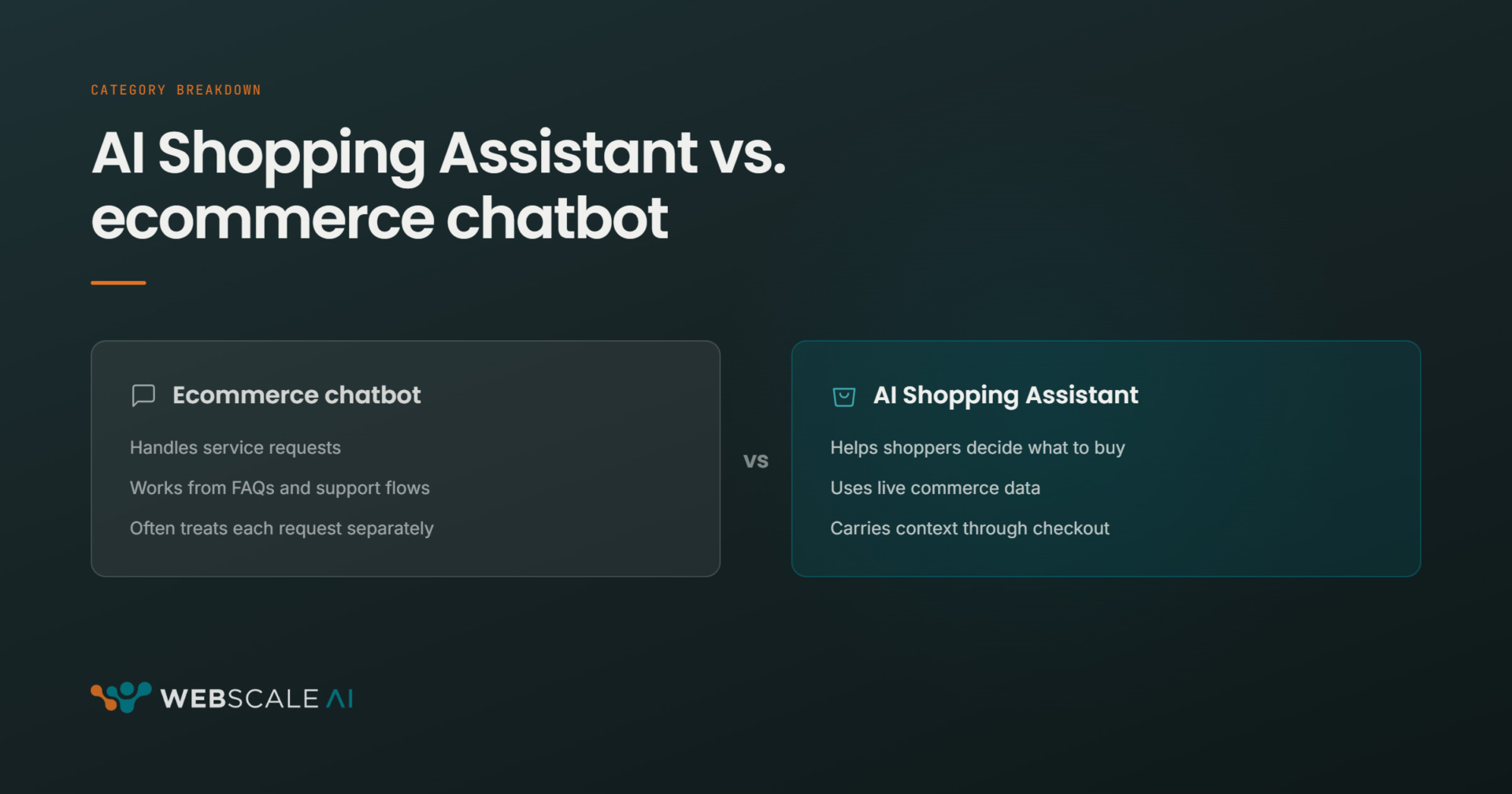
| “This is not a chatbot answering FAQ questions. It is an AI agent executing against the complexity of a real B2B commerce relationship.” |
WHY GENERIC TOOLS FAIL
Why Do Standard AI Tools Fail in B2B Contexts?
The B2C AI shopping assistant market has produced a generation of tools that work reasonably well for their intended context: anonymous shoppers browsing an open catalog with no account-specific constraints. Deploying those tools in a B2B dealer portal context produces failures that are specific, predictable, and rooted in the same architectural mismatch.
Generic AI tools do not understand account context.
A B2B buyer has a pricing tier, an approved product list, a purchase history, a credit standing, and often a set of catalog restrictions tied to their distributor agreement. A generic chatbot shows every user the same catalog at the same pricing, which in a B2B context means it is showing prices and products that many users cannot actually access. This is a fundamental disqualifier for procurement use.
Generic AI tools cannot handle multi-line orders.
B2B purchases are frequently 10 to 50 line items. A conversational assistant that handles one product at a time is operationally useless for building a dealer reorder. The workflow it replaces is more efficient than a tool that requires 40 separate conversational turns to achieve the same result.
Generic AI tools lack SKU-level intelligence.
B2B buyers often know exactly what they need by part number or technical specification. A tool that cannot take a SKU as an input, confirm it exists in the catalog at the buyer’s contracted price, verify current stock, and identify compatible alternatives is not useful in a procurement context.
Generic AI tools are open-ended in ways that create liability.
A chatbot that can go off-topic, provide inaccurate specifications, or generate product compatibility claims without verification is a risk in a B2B purchasing context. Guardrailed scope is a requirement, not a limitation.
WHAT READINESS LOOKS LIKE
What Does an AI-Ready B2B Dealer Portal Look Like?
An AI-ready B2B dealer portal has five characteristics that together define what it means to serve a B2B buyer with genuine AI capability.
Account-aware AI is the first and most fundamental.
The shopping assistant knows who is logged in, including their pricing tier, approved product list, purchase history, credit standing, and any account-specific catalog restrictions. Every recommendation is filtered through that account context automatically.
Catalog intelligence at the SKU level is the second.
The assistant can process any query a B2B buyer might actually use: a SKU number, a technical description, a compatibility requirement. It returns accurate, account-specific results, not generic search results that require the buyer to filter and interpret.
Reorder automation is the third.
A dealer can initiate a reorder by describing what they need in operational terms and the assistant drafts the full purchase order for review based on purchase history, current inventory levels, and account-specific order minimums.
First-party behavioral data is the fourth.
The portal tracks what dealers browse, compare, and purchase over time, and uses that behavioral history to surface proactive recommendations. This turns a transactional portal into a relationship tool.
Guardrailed scope is the fifth.
The assistant is bound to commerce-specific tasks: product discovery, reorder assistance, catalog Q&A, account inquiry, order status. In a procurement context, this operational discipline is a feature, not a limitation.
HOW WEBSCALE ADDRESSES IT
How Does Webscale’s AI Shopping Assistant Work for B2B?
Webscale’s AI Shopping Assistant was built for the infrastructure layer of Adobe Commerce and Shopware dealer portals, with direct access to account-specific pricing, catalog restrictions, and purchase history. It does not require a separate integration or data sync configuration. It runs as part of the Webscale delivery stack, which means every account-specific parameter is available from the moment a dealer logs in.
The B2B-specific capabilities that distinguish it from generic assistants include account-based catalog and pricing filtering, purchase history access for reorder and repeat-purchase flows, complex catalog navigation built for large SKU sets with technical attribute matching, and commerce-scoped guardrails appropriate for procurement deployment. Together with the Agentic Commerce OS, it is the infrastructure layer that makes the AI-ready B2B portal achievable without replatforming.
| The B2B buying experience is about to change as dramatically as B2C ecommerce changed between 2005 and 2015. The portals that meet dealers and procurement buyers with AI-native interfaces will earn their engagement and their loyalty. Those that do not will look increasingly dated. |
Frequently asked questions
How is B2B agentic commerce different from B2C?
Multi-party authorization across procurement, finance and end user. Contract pricing with negotiated rates and volume tiers. Approval workflows with PO requirements and spending limits. All things B2C doesn’t have to worry about at the same scale.
Does B2B agentic commerce work on dealer portals built on Magento or Adobe Commerce?
Yes. Adobe Commerce B2B already supports the company account structure, negotiable quotes and shared catalogs that agentic flows need.
What’s the biggest blocker for B2B agentic commerce?
ERP integration. Most B2B sites pull inventory and pricing from an ERP. The agent needs real-time access to those systems in addition to the storefront.
How do distributors maintain the dealer relationship in an agent-led purchase?
By owning the portal and the agent-merchant integration. Distributors who lose the agent layer to a third party (a marketplace, an AI platform) lose visibility into their dealers.
When will B2B agentic commerce become standard?
Adoption lags B2C. Early adopters in industrial supply, electrical, plumbing and office distribution are beginning to pilot in 2026.
Ready to build an AI-ready B2B dealer portal? See how Webscale’s Agentic Commerce OS handles the infrastructure layer.