WHAT IT IS
What Is Natural Language Segmentation?
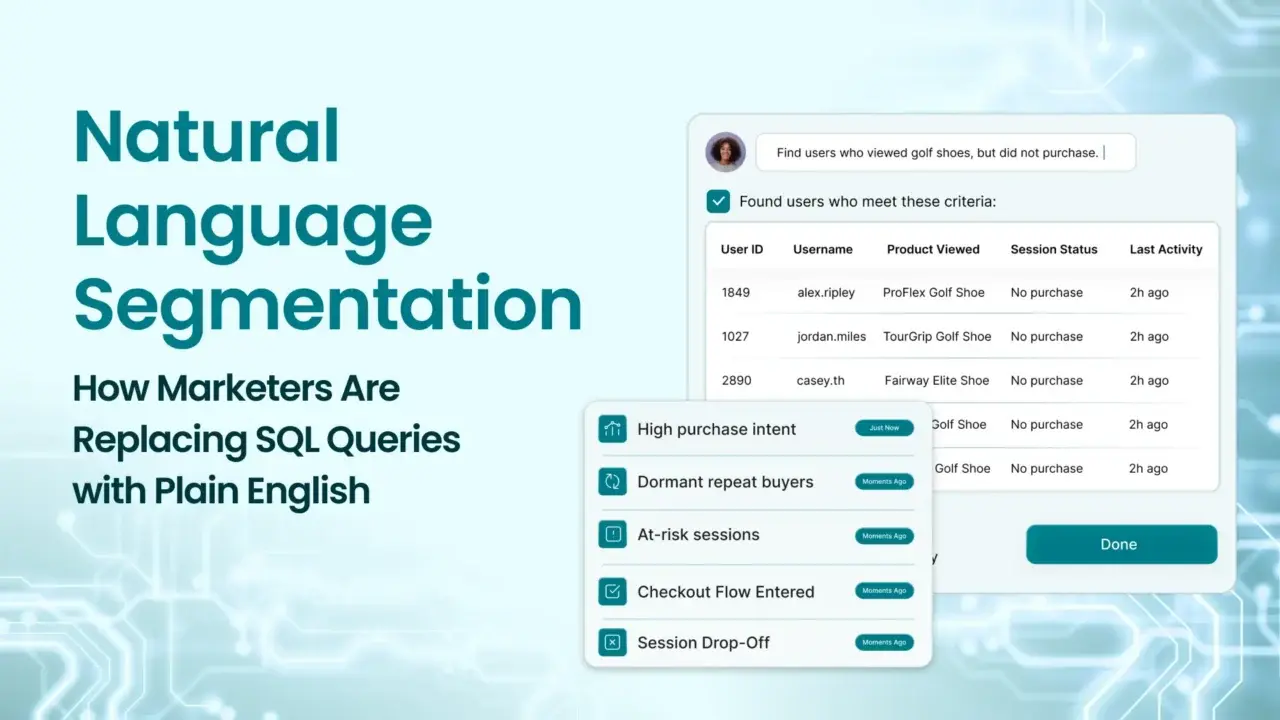
Natural language segmentation is the ability to describe a target audience in conversational language and have an AI system produce a precise, executable audience segment that reflects exactly what was described.
The practical comparison is direct. The SQL rule for a standard win-back campaign segment looks like this:
purchase_count_90d > 0 AND last_purchase_date < NOW() - 90 AND lifetime_value > 500The natural language equivalent is: “Customers who bought something in the last 90 days but have not come back, with a lifetime value over $500.” Both produce the same segment. The first requires a data analyst. The second requires the ability to describe a customer type in ordinary language which every member of a marketing team can do.
“Natural language segmentation that works correctly requires the AI to understand business intent and generate accurate query logic against structured behavioral data. It does not work without a clean first-party data foundation“
WHY CURRENT TOOLS FALL SHORT
Why Do Traditional Segmentation Tools Fall Short?
Three failure modes explain why marketing teams at well-resourced mid-market merchants still wait days for segments despite years of investment in marketing automation platforms and data infrastructure.
Failure Mode 1: SQL-Only Tools
Data warehouses and BI platforms are technically capable of producing any segment a marketer could describe, but they require SQL knowledge to query. Marketing operators cannot use them directly. Every segment request becomes a ticket to the data team, and the data team has a backlog of requests from across the organization. The bottleneck is architectural, not effort-related.
Failure Mode 2: Rule-Builder Interfaces
Rule-builder interfaces in marketing automation platforms work well for simple conditions: customers who clicked this email, customers in this geographic region. The complexity ceiling appears quickly once a segment requires multiple data sources, custom time windows, or behavioral pattern conditions. For the kinds of nuanced, behavior-specific segments that drive the highest-performing campaigns, rule builders produce either an approximation or an error.
Failure Mode 3: Natural Language Interfaces Layered on Poor Data Quality
Several platforms have added natural language query interfaces to their segmentation tools in the past two years. The problem is that if the underlying behavioral data is fragmented across GA4, Meta Pixel, a CRM, and an email platform — none of which share a unified shopper identity — the segment is built quickly but built wrong. The campaign underperforms. Nobody immediately identifies the data quality as the root cause.
WHAT IT ENABLES
What Does Natural Language Segmentation Enable?
Five concrete use cases illustrate the operational difference that natural language segmentation makes when built on a complete, unified, real-time behavioral data layer.
- Win-back campaigns. “Customers who purchased twice but have not ordered in 120 days and whose last order was over $300.” Built in 30 seconds and pushed to Klaviyo before the timing window closes.
- High-LTV lookalike audiences. “My top 500 customers by lifetime value in the last 12 months.” Exported directly to Meta for lookalike audience modeling, no data team involvement.
- Seasonal replenishment targeting. “Customers who bought outdoor furniture last spring but have not purchased anything in that category this season.” Pushed to Google Ads for display retargeting in the two weeks before Memorial Day weekend.
- At-risk subscriber identification. “Email subscribers who opened the last three campaigns but have not purchased in 90 days.” Flagged for a promotional offer sequence, built and activated in the same morning the campaign idea was developed.
- B2B account reactivation. “Dealer accounts that placed more than five orders last year but have not ordered in Q1 this year.” Surfaced for direct sales outreach in ten minutes rather than discovered weeks later.
In each case, the segment that would have taken three to five business days is built in 30 seconds. The campaign launches when the timing is right, not when the queue clears.
THE FOUNDATION REQUIREMENT
What Makes It Work: The Data Foundation Requirement
Natural language segmentation is the visible interface. The first-party data infrastructure underneath it is what determines whether the outputs are accurate.
If behavioral data is fragmented across GA4, Meta Pixel, and a CRM, none of which share a unified shopper identity, the query logic the AI generates cannot join those sources into a coherent picture of any individual shopper’s behavior.
If behavioral data is sampled or delayed, the segment reflects what was happening last week, not what is happening now. The win-back campaign built on 90-day behavioral data is actually built on 97-day behavioral data, because the tag collection has a lag and the warehouse sync runs weekly.
This is why natural language segmentation and a CDP are not independent decisions. They are the two layers of the same infrastructure investment: the CDP ensures behavioral data is complete, unified, real-time, and identity-resolved; AI Segmentation is the activation layer that makes that data accessible to marketing teams in the language they already speak.Webscale’s AI Segmentation runs on top of the Webscale CDP: infrastructure-layer behavioral data that is always complete, always current, and always under the merchant’s control. Marketing teams build segments in plain English. The AI generates the correct query logic. The results push directly to Klaviyo, Meta, and Google Ads without a data team in the middle.
The marketing team that can build its own segments, precisely, in plain English, in 30 seconds, operates fundamentally differently from one that waits days for fulfillment. Natural language segmentation is not a marginal efficiency improvement. It is a structural change in how marketing teams relate to their data.