THE FOUR PILLARS
What Are the Four Pillars of AI Commerce Readiness?
Pillar 1: Product Data Quality and Structure
AI agents evaluate products based on structured data: attributes, pricing, availability, images, specifications, compatibility parameters, return policies, and shipping terms. A merchant with incomplete attribute sets, batch-updated pricing, or unstructured policy information is a lower-confidence selection, and agents calibrated to optimize for the shopper’s outcome will select higher-confidence options when available.
What readiness looks like:
- All products have complete attribute sets with no missing fields in the categories agents evaluate
- Pricing and inventory are synchronized in real time, not through daily or weekly batch processes
- Return and shipping policies are structured in machine-readable schema markup, not embedded in prose
- Product descriptions are specific and factual rather than marketing-optimized
Pillar 2: First-Party Behavioral Data
AI agents personalize recommendations based on behavioral signals. Merchants who provide clean, structured first-party behavioral data through their infrastructure layer enable more accurate, more confident recommendations. Merchants whose behavioral data is fragmented across tags and external platforms produce noisy signals that agents cannot reliably act on.
What readiness looks like:
- A CDP captures all behavioral events at the storefront in real time, at the infrastructure layer rather than through third-party tags
- Shopper profiles are unified across devices and sessions, so behavioral context is complete rather than fragmented
- Behavioral data is available via API, not only visible in analytics dashboards that require a human to interpret
Pillar 3: API Accessibility
Google UCP and OpenAI Commerce APIs require that AI agents can query a merchant’s inventory, pricing, and checkout flow programmatically. Merchants with session-dependent checkout flows that cannot accept programmatic requests will be excluded from Agentic Checkout regardless of how well their catalog data and behavioral signals are structured.
What readiness looks like:
- The product catalog is accessible via API with real-time pricing and inventory
- The checkout flow supports delegated agent authentication
- Order management can accept and confirm agent-initiated transactions in machine-readable format
Pillar 4: On-Site Conversational Capability
Merchants who deploy AI shopping assistants on their storefronts generate the specific interaction signals that train AI engines to understand the relationship between shopper intent and a merchant’s catalog. This is a compounding advantage: the more high-quality conversational interactions a merchant’s storefront produces, the more accurately AI engines represent that merchant’s catalog.
What readiness looks like:
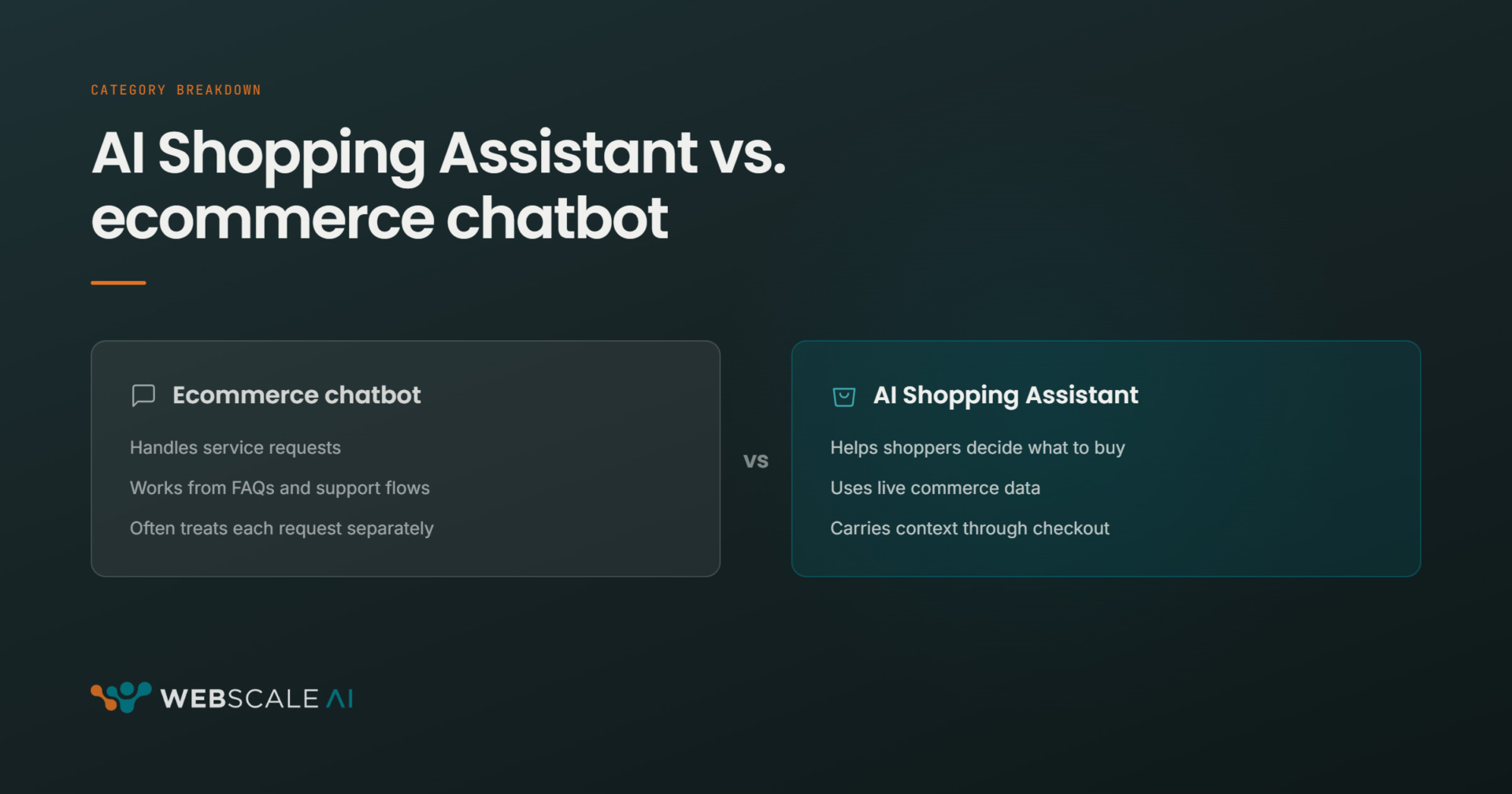
- An AI Shopping Assistant handles product discovery, comparison, catalog Q&A, and order support on the storefront, scoped to commerce tasks
- Conversation data is captured and structured in a form that contributes to the merchant’s behavioral data layer
- The assistant produces intent-rich interaction data as a byproduct of improving on-site conversion
WHERE MOST MERCHANTS STAND
Where Do Most Merchants Currently Stand?
An honest assessment of mid-market merchants on Adobe Commerce, Magento, and Shopware against these four pillars produces a consistent picture: partial readiness on Pillar 1, low readiness on Pillar 2, low readiness on Pillar 3, and zero readiness on Pillar 4.
Pillar 1 is the most common partial success. Most merchants have reasonable product data for their core catalog, but gaps tend to appear at the edges: tail catalog products with incomplete attributes, schema markup that covers some product types and not others, and policies written for human readers rather than machine parsing.
Pillar 2 is the most common significant gap. Almost universally, mid-market merchants are collecting behavioral data via third-party tags, which means the behavioral data layer is degraded by browser privacy features, ad blockers, and iOS tracking restrictions.
Pillars 3 and 4 are largely unaddressed. Most mid-market commerce backends are not built for programmatic agent access, and most mid-market storefronts do not have conversational AI capability at all.
The important counterpoint is that none of these gaps require replatforming. All four pillars can be addressed at the infrastructure and data layer, on top of an existing Adobe Commerce, Magento, or Shopware installation, without disrupting existing commerce operations.
HOW WEBSCALE ADDRESSES IT
How Does Webscale Address All Four Pillars?
Webscale’s Agentic Commerce OS maps to each pillar of AI commerce readiness directly.
The CDP addresses Pillar 2:
infrastructure-layer behavioral data collection, real-time unified profiles, and behavioral data accessible via API so agents can query it directly when personalizing recommendations.
AI Segmentation enhances Pillar 2 further:
structured behavioral intelligence built on CDP data, queryable by marketing teams in plain English, and available for agent personalization through clean and current data structures.
The AI Shopping Assistant addresses Pillar 4:
on-site conversational capability with commerce-scoped guardrails that generate the intent signals AI engines learn from. A merchant whose storefront responds to natural language queries is producing behavioral signals that compound into citation authority over time.
Webscale’s delivery layer addresses Pillar 3:
the commerce backend becomes API-accessible without replatforming, and the programmatic access that Agentic Checkout requires is enabled as part of the infrastructure deployment.
Pillar 1, product data quality, requires merchant-side catalog work. Webscale’s team can advise specifically on what attribute completeness, schema markup, and real-time sync look like for Google UCP and OpenAI Commerce API compatibility.
Learn how Webscale addresses all four pillars
| The merchants who prepare for AI-mediated commerce in Q2 2026 will be positioned to capture agent-initiated transactions when this model reaches scale in Q3 and Q4. The window to establish structured data quality, behavioral data infrastructure, and conversational storefront capability is open. It will not stay open indefinitely. |